The Bridge Program
The Bridge Program at The Bridges Academy is a thoughtfully designed experience for fourth and fifth graders, blending the best elements of our Lower and Middle School programs. During these pivotal years, students build strong academic foundations in reading, writing, and math while engaging in a well-rounded curriculum that includes foreign language, STEAM, music, and art.
More importantly, the Bridge Years focus on who students are becoming. As children begin
early adolescence, they are navigating increased academic expectations, changing routines, and growing social awareness. Rather than placing fifth grade into a traditional middle school model, The Bridges Academy provides a distinct, developmentally appropriate program designed specifically for this stage of growth.
Students learn together as a supportive “pod,” with a dedicated team of teachers and a designated space on campus to call their own. Alongside academics, intentional
emphasis is placed on essential life skills such as organization, time management, study habits, academic integrity, and self-advocacy. With guidance from caring educators and specialists, students also develop healthy peer relationships while learning to navigate challenges such as conflict resolution, decision-making, and social dynamics—laying the groundwork for a confident, successful transition into middle school and beyond.

Designed for the In-Between Years.

English Language Arts
This course is designed to build strong readers, thoughtful writers, and confident communicators. Using Savvas MyView Literacy, novel studies, and Sadlier Vocabulary Workshop, students will explore a wide range of texts while developing essential reading, writing, grammar, and vocabulary skills.
-
Author Studies
-
Author's Purpose
-
Cause and Effect
-
Compare and Contrast
-
Draw Conclusions
-
Fact and Opinions
-
Generalize
-
Literary Elements
-
Main Idea and Details Sequencing
-
Grammar
-
Narrative
Opinion
Information
Persuasive
18 Units of Study
Stories and 12 words of Study
Mathematics
This course is designed to strengthen students’ mathematical understanding, problem-solving skills, and confidence with numbers. Using Origo Stepping Stones, students will build a strong foundation in number sense while applying math concepts to real-world situations.
Throughout the year, students will deepen their understanding of place value and work fluently with whole numbers, decimals, and fractions. Instruction focuses on adding, subtracting, multiplying, and dividing, including multi-digit whole numbers, decimals, and fractions. Students will also write and interpret numerical and algebraic expressions, helping them recognize patterns and relationships in math.
In addition, students will develop skills in measurement, geometry, and data analysis. They will interpret data, understand and calculate volume, convert measurements, explore geometric measurement, and graph points on a coordinate plane. By the end of the year, students will be able to think critically, solve problems efficiently, and explain their mathematical reasoning with clarity and confidence.
Understanding Place Value
Adding and subtracting decimals
Fluently multiply multi-digit whole numbers
Fluently multiply decimals
Add and subtract fractions
Multiply and divide fractions
Interpret data
Understand volume
Convert measurements
Write and interpret numerical expressions
Graph points on a coordinate plane
algebraic expressions
Geometric measurement
Science
This course encourages students to explore the natural world through observation, investigation, and hands-on learning. Using Savvas Interactive Science, students build a strong foundation in scientific concepts while developing curiosity, critical thinking, and problem-solving skills.
Throughout the year, students study physical science topics such as energy and heat, motion, and electricity, learning how forces and energy affect everyday life. In life science, students explore plants, animals, and ecosystems, examining how living things interact with one another and their environment. Earth science units focus on Earth’s resources and the importance of conservation and responsible use.
Students also engage in technology and design, applying scientific knowledge to solve problems through planning, testing, and improving ideas. Emphasis is placed on understanding the nature of science, including asking questions, conducting investigations, analyzing results, and communicating findings. Through research projects and inquiry-based activities, students strengthen their ability to think like scientists. By the end of the year, students will have a deeper understanding of scientific concepts and the skills needed to explore, question, and understand the world around them.
Energy and Heat
Motion
Electricity
Plants and Animals
Ecosystems
Earth’s Resources
Technology and Design
Nature of Science
Research Class
Technology is mindfully used in many levels of our academic and extracurricular programs at Bridges. Our STEAM (science, technology, engineering, art and math) program begins in nursery. Technology is introduced in Pre-K and used as a tool to identify and solve problems, present and share ideas, and document and reflect on work. It gives physical projects a voice and allows a student's work to come alive. Technology is also used to build digital portfolios of student growth that can easily be shared with parents. At Bridges, technology rarely stands alone. It is often blended with a hands-on, collaborative project that incorporates the design thinking process.
Our program is based on the standards created by ISTE (International Society for Technology in Education.) These standards are designed to empower student voice and ensure that learning is a student-driven process.
In the STEAM Lab, students engage in collaborative projects that are frequently interdisciplinary. These STEAM lessons are carefully designed to connect with or enhance the classroom curriculum.
The spiraling curriculum aims to develop students’ technology and design skills in areas such as coding, keyboarding, robotics, circuit building, cardboard construction and the design thinking process. These skills serve as the foundation for ongoing work throughout Bridges. Woven throughout the STEAM program is ongoing learning about digital citizenship and the responsible use of technology both in the classroom and at home. This becomes increasingly important as students get older and transition to their own devices.
Social Studies
This course helps students develop an understanding of geography, history, government, and civic responsibility, with a strong focus on New York State and its place in the world. Using Savvas My World Social Studies (New York Edition) and The Long Island Story, students explore how geography, people, and events have shaped communities over time.
Throughout the year, students study the geography of Long Island, New York State, the United States, and the world, learning how location, landforms, and resources influence daily life and historical development. Students examine key historical periods, including Three Worlds Meet, Colonial New York, the Revolutionary War in New York State, the formation of a new nation, social change during the Civil War, and New York’s transformation through industrial growth and modernization.
Students also learn about New York State government and civic life, gaining an understanding of leadership, laws, and citizens’ roles, and explore how New York continues to evolve in the 21st century. Through research projects and inquiry-based learning, students develop skills in questioning, analyzing sources, and presenting information clearly. By the end of the year, students will have a deeper understanding of history and geography, stronger research skills, and a greater appreciation for their role as informed citizens.
Geography of Long Island
Geography of New York State
Geography of United States
Geography of the World
Three Worlds Meet
Colonial New York
The Revolutionary War in NY State
A New Nation
Social Change in the Civil War
New York Transforms
New York Government
New York in the 21st Century
Research Class
World Languages
Communication
Interpersonal mode: participate in basic conversations (oral and written) in a variety of familiar and predictable topics, using isolated words and learned phrases.
Interpretive mode: comprehend short written or oral exchanges on topics that use learned vocabulary and grammatical structures.
Presentational mode: present using learned phrases and expressions (written or oral) on familiar topic
Cultures, Connections & Comparisons
Describe and reproduce common practices of other cultures
Summarize information gathered from resources connected to other content areas (i.e: current events)
Study similarities and differences of basic structural patterns of student’s own language and the target language. (i.e: Latin roots, cognates)
Structure
Articles, nouns, adjectives, subject pronouns, tu vs. vous, present tense, er, ir, re verbs, irregular verbs, past tense, negation, possessive adjectives, yes/no questions, commands, prepositions, adverbs
Context
Personal information, greetings/leave-takings, alphabet, numbers, calendar, weather/seasons, time/schedules/24 hour clock, emotions/feelings, expressions of well-being, opinions, sports/leisure activities, food/drinks/cafés, school, celebrations, nationalities, professions, geography, currency, basic health, parts of the body
Physical Education
Chasing, fleeing, dodging
Speed, agility
Defending space
Understanding the roles of offense and defense
Combination movement
Locomotor + non-locomotor+manipulative
Throwing and Catching (advanced)
Striking- with and without objects
Passing
Shooting
Rolling (advanced)
Volleying individually and with partners
Working together
Problem solving skills
Communication skills
Good Sportsmanship
Unit 1: Personal Health
Unit 2: Growth and Development
Unit 3: Nutrition and Physical Activity
Unit 4: Healthy Choices
Unit 5: Safety Awareness
Unit 6: Environmental Consumer HealthSoccer
Football
Team Handball
Basketball
Jump Rope
Scooter Hockey
Volleyball
Bowling
Lacrosse
Kickball
Wiffle-ball
The Arts
Drawing and painting animals, people, landscapes and master artist works.
How to use chalk and oil pastels, watercolor paints, markers, colored pencils. How to blend the medium for a more 3-dimensional effect
Combining mediums, learning which mediums work well together
Learning color wheel: primary, secondary, complementary, tertiary, neutral colors
Understanding positive and negative space
Drawing proportions of the face and the human figure
Elements of Art: line, shape, color, value, texture, form and space
How to choose a medium for a project and what types of brushes to use for each type of paint
Painting on canvas
Using clay to make animals
Building art appreciation by viewing artworks by famous artists and re-creating an artwork
One and two point perspective drawing
Introduction to photography
Understanding the process of printmaking
Creating a collaborative project with the class for our Art Auction
Preparing artwork to be displayed in the three yearly art shows
How to use technology in Art
Learning about careers in the Art field
Art Portfolio preparation for those looking to continue art in High School
Genre studies
Exposure to historical figures in music and their cultural significance
Recognizing historically significant pieces of music
Study of multicultural music and the cultures of the countries studied
Performing pieces of music individually and/or as a group
Performing music either vocal or instrumental
Chorus
Performing music with technical accuracy and stylistic expression, such as tempo and dynamics
Demonstrate performance decorum, such as stage presence, attire, and behavior
Demonstrate audience etiquette appropriate for venue, purpose, and context
Display appropriate posture and breathing techniques for performing ensembles
Apply teacher provided and collaboratively developed feedback to evaluate ensemble performances.
The students will focus on:
Performing music with technical accuracy and stylistic expression, such as tempo and dynamics
Demonstrate performance decorum, such as stage presence, attire, and behavior
Demonstrate audience etiquette appropriate for venue, purpose, and context
Apply teacher provided and collaboratively developed feedback to evaluate ensemble performances.
Students in fourth through eighth grade have the opportunity to participate in an age appropriate theatrical performance. Students learn the ins-and-outs of performing a musical on stage including but not limited to:
Character dialogue
Staging and Blocking
Choreography
Memorizing songs and lines
Working collaboratively with others to complete a show
Basic set design and construction


Strong Academics. Stronger Transitions.
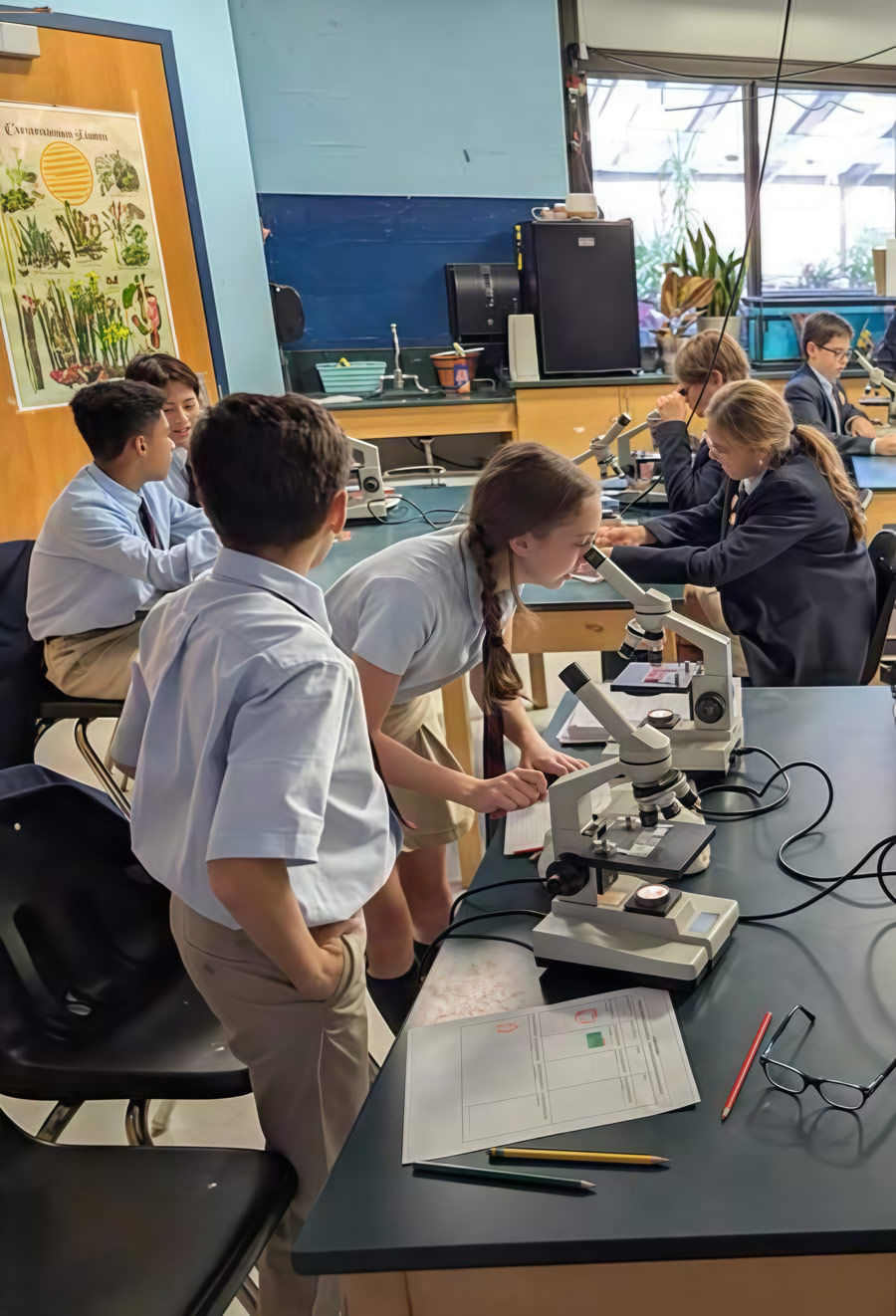
Preparing Students for What’s Next.

English Language Arts
This course aims to provide a comprehensive framework covering literature and literary analysis, essay writing in different genres, grammar, and vocabulary. By the end of the year, students will have developed critical thinking skills, improved their writing abilities, and expanded their knowledge and understanding of the English language.
Author studies
Author’s Purpose
Cause and effect
Compare and contrast
Inference and drawing conclusions
Fact vs opinion
Literary Elements
Non-fictional text
Main Idea and supporting details
Grammar
Vocabulary (both Sadlier and My View)
Narratives
Opinion
Informational
Persuasive
Mathematics
Using the Origo Stepping Stones program, students strengthen mathematical reasoning, problem-solving, and computational fluency. Instruction focuses on place value, operations with whole numbers, decimals, and fractions, algebraic thinking, numerical expressions, measurement, volume, coordinate graphing, geometry, data interpretation, and real-world applications that build confidence and mathematical understanding.
Understanding Place Value
Adding and subtracting decimals
Fluently multiply multi-digit whole numbers
Fluently multiply decimals
Add and subtract fractions
Multiply and divide fractions
Interpret data
Understand volume
Convert measurements
Write and interpret numerical expressions
Graph points on a coordinate plane
algebraic expressions
Geometric measurement
Science
Through the Savvas Interactive Science program, students investigate physical, life, and Earth sciences while developing scientific inquiry and critical thinking skills. Topics include matter, forces and motion, ecosystems, growth and survival, weather, and the water cycle. Students apply the scientific method through hands-on investigations, participate in the annual Science Fair, and explore health, wellness, engineering, and technology concepts.
Physical Science
Properties of Matter
Forces and Motion
Life Science
Growth and Survival
Ecosystems
Earth Science
The Water Cycle and Weather
Earth and Science
Science, Engineering, and Technology Skills Handbook
The Nature of Science
Design and Function
In School Science Fair
Scientific Method
Health and Wellness
Health Promotion and Disease Prevention
Influence of Family, Peers, Culture, Media, and Technology on Health Behaviors.
Access Valid Health Information, Products and Services
Interpersonal Communication Skills to Enhance Health and Reduce or Avoid Risks
Decision-Making Skills to Enhance Health
Goal Setting Skills to Enhance Health
Advocate for Individual, Peer, School, Family, and Community Health
Social Studies
Using Savvas MyWorld Interactive, students explore the history of the United States from the American Revolution through Reconstruction. They examine the founding of the nation, the Constitution and Bill of Rights, westward expansion, the Civil War, and Reconstruction while developing historical thinking, analyzing primary and secondary sources, and making connections between past events and the world today.
The American Revolution
-
Tensions with Britain
-
The Road to War
-
Declaring Independence
-
On the Battlefield and at Home
-
Winning Independence
A New Nation
-
Articles of Confederation
-
Creating the Constitution
-
The Bill of Rights
Key Concepts of the Constitution
-
Life in the Young Republic
-
The First Presidents
-
Jefferson and the Louisiana Purchase
-
The War of 1812
-
American Indians and the Trail of Tears
-
New Arrivals and the Fight for Freedom
Westward Expansion
-
Inventions Roads and Railroads
-
Independence for Texas and California
-
Trails to the West
-
The California Gold Rush
Civil War and Reconstruction
-
Struggles over Slavery
-
The War Begins
-
Life During the Civil War
-
The War Ends
-
Reconstruction
-
World Languages
-
Communication
-
Interpersonal mode: participate in basic conversations (oral and written) in a variety of familiar and predictable topics, using isolated words and learned phrases.
-
Interpretive mode: comprehend short written or oral exchanges on topics that use learned vocabulary and grammatical structures.
-
Presentational mode: present using learned phrases and expressions (written or oral) on familiar topic
-
-
Cultures, Connections & Comparisons
-
Describe and reproduce common practices of other cultures
-
Summarize information gathered from resources connected to other content areas (i.e: current events)
-
Study similarities and differences of basic structural patterns of student’s own language and the target language. (i.e: Latin roots, cognates)
-
-
Structure
-
Articles, nouns, adjectives, subject pronouns, tu vs. vous, present tense, er, ir, re verbs, irregular verbs, past tense, negation, possessive adjectives, yes/no questions, commands, prepositions, adverbs
-
-
Context
-
Personal information, greetings/leave-takings, alphabet, numbers, calendar, weather/seasons, time/schedules/24 hour clock, emotions/feelings, expressions of well-being, opinions, sports/leisure activities, food/drinks/cafés, school, celebrations, nationalities, professions, geography, currency, basic health, parts of the body
-
-
Physical Education
-
Fitness testing
-
Cardiovascular endurance
-
Muscular Strength and Endurance
-
Flexibility
-
Create a self fitness plan
-
Balance of proper nutritious foods and exercise
-
-
Demonstrate proficiency in:
-
Throwing and Catching
-
Kicking and punting
-
Passing and shooting
-
Dribbling
-
Volleying and striking
-
-
Working together
-
Communication
-
Problem-solving skills
-
Leadership and listening
-
Critical thinking
-
Good Sportsmanship
-
-
Understanding and demonstrating strategy in games
-
Understanding rules of various sports
-
Having a basic understanding of various team sports and being able to demonstrate the basic and advanced skills required to play:
-
Soccer
-
Football
-
Team Handball
-
Basketball
-
Scooter Hockey
-
Volleyball
-
Badminton
-
Lacrosse
-
Kickball
-
Wiffle ball
-
-
The Arts
-
Drawing and painting animals, people, landscapes and master artist works.
-
How to use chalk and oil pastels, watercolor paints, markers, colored pencils. How to blend the medium for a more 3-dimensional effect
-
Combining mediums, learning which mediums work well together
-
Learning color wheel: primary, secondary, complementary, tertiary, neutral colors
-
Understanding positive and negative space
-
Drawing proportions of the face and the human figure
-
Elements of Art: line, shape, color, value, texture, form and space
-
How to choose a medium for a project and what types of brushes to use for each type of paint
-
Painting on canvas
-
Using clay to make animals
-
Building art appreciation by viewing artworks by famous artists and re-creating an artwork
-
One and two point perspective drawing
-
Introduction to photography
-
Understanding the process of printmaking
-
Creating a collaborative project with the class for our Art Auction
-
Preparing artwork to be displayed in the three yearly art shows
-
How to use technology in Art
-
Learning about careers in the Art field
-
Art Portfolio preparation for those looking to continue art in High School
-
-
Genre studies
-
Exposure to historical figures in music and their cultural significance
-
Recognizing historically significant pieces of music
-
Study of multicultural music and the cultures of the countries studied
-
Performing pieces of music individually and/or as a group
-
Chorus
-
Performing music with technical accuracy and stylistic expression, such as tempo and dynamics
-
Demonstrate performance decorum, such as stage presence, attire, and behavior
-
Demonstrate audience etiquette appropriate for venue, purpose, and context
-
Display appropriate posture and breathing techniques for performing ensembles
-
Apply teacher provided and collaboratively developed feedback to evaluate ensemble performances.
-
Performing music either vocal or instrumental
-
-
Students in fourth through eighth grade have the opportunity to participate in an age appropriate theatrical performance. Students learn the ins-and-outs of performing a musical on stage including but not limited to:
-
Character dialogue
-
Staging and Blocking
-
Choreography
-
Memorizing songs and lines
-
Working collaboratively with others to complete a show
-
Basic set design and construction
-
Learn More
Learn more about our Head of School Stephen Edward Rubenacker.
Why Choosing a Private School might be right for your family.
Learn more about our admissions process and schedule a tour.
Explore our media page where you can watch school events, plays, and days of learning.